
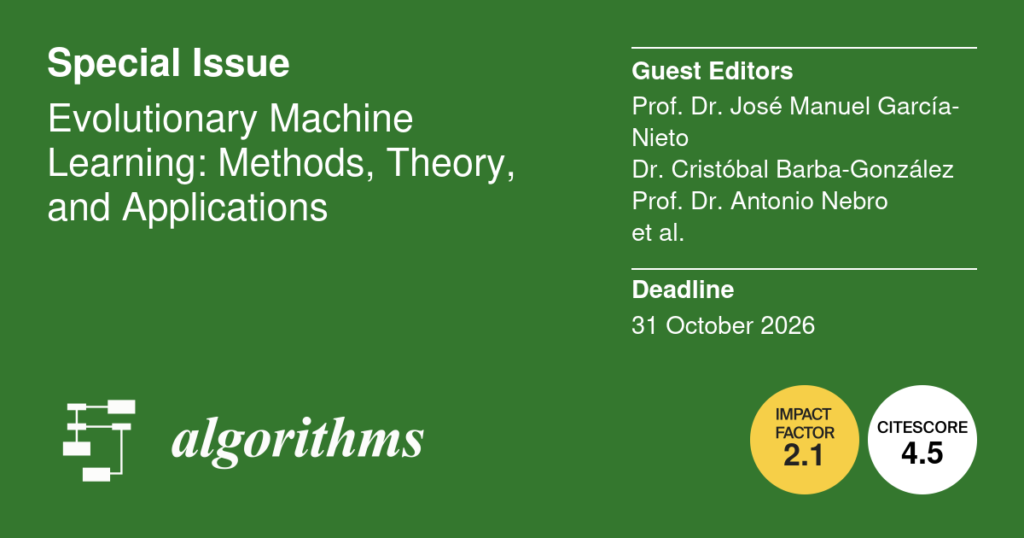
Evolutionary Machine Learning: Methods, Theory, and Applications
Evolutionary Machine Learning (EML) is establishing itself as a rapidly expanding research field that combines evolutionary computation with machine learning to tackle complex, high-dimensional, and difficult-to-optimize problems. Through evolutionary algorithms, genetic programming, and bio-inspired methods, EML provides effective mechanisms for the design, adaptation, and improvement of intelligent models.
These approaches have proven effective in tasks such as optimizing model structures, selecting and building features, automatically tuning hyperparameters, ensemble learning, and searching for neural architectures. Furthermore, they play a fundamental role in emerging paradigms such as AutoML, federated learning, and transfer learning, where adaptive and distributed optimization is key.
In addition, there is growing interest in applying machine learning techniques to analyze and refine the behavior of the evolutionary algorithms themselves. This includes automatic algorithm configuration, adaptive operator selection, performance prediction, and dynamic, data-driven parameter control.
In this context, a new special issue will bring together theoretical advances, algorithmic developments, and practical applications of Evolutionary Machine Learning (EML), fostering collaboration between the evolutionary computing and machine learning communities. The initiative is coordinated by Prof. Dr. José Manuel García-Nieto, Dr. Cristóbal Barba-González, Prof. Dr. Antonio J. Nebro, and Dr. Sandro Hurtado, who invite researchers from around the world to contribute papers that will shape the future of machine learning based on evolutionary principles.
Contact
info@kosmos.uma.es

Proyect Funding

Project Code
PID2024-155363OB-C41 Universidad de Málaga (UMA)
PID2024-155363OB-C42 Universidad de Sevilla (US)
PID2024-155363OB-C43 Universidad de Alicante (UAL)
PID2024-155363OB-C44 Universidad de Castilla y La Mancha (UCLM)